
Featured Industrial Labeling & Card Products
High-performance custom adhesive labels, specialized films, thermal transfer substrates, and structural print solutions engineered for global industrial and commercial compliance.
Executive Summary: The Critical Role of Lithium Battery Labels in Global Energy Storage
The global transition toward electrification—spanning Electric Vehicles (EVs), Energy Storage Systems (ESS), portable consumer electronics (3C), and heavy industrial equipment—has placed unprecedented performance demands on lithium-ion battery packaging. Within this high-tech manufacturing ecosystem, the **lithium battery label** is far more than an aesthetic identifier. It serves as an essential safety component, regulatory compliance mechanism, operational tracking unit, and thermal runaway warning barrier.
Information Gain Key Insight: Unlike standard pressure-sensitive labels, lithium battery stickers must maintain structural integrity, legend legibility, and adhesive shear strength across extreme chemical environments (exposure to electrolyte solvent leaks like LiPF6), intense thermal stress (-40°C to +300°C), and electrical insulation requirements up to several kilovolts.
As the undisputed global epicenter of lithium battery manufacturing—housing supply chain giants such as CATL, BYD, EVE Energy, and CALB—China has developed an integrated, highly specialized industrial network for producing advanced battery labels. Chinese labeling manufacturers combine cutting-edge material science (Polyimide, PET, Polycarbonate, Flame-retardant Synthetic Papers) with precision rotary die-cutting and automated visual inspection systems to meet stringently enforced international standards including **UL 969**, **UN 38.3**, **IEC 62133**, and **BS5609 marine immersion protocols**.
Why Sourcing Lithium Battery Labels from China Factories Unlocks Supply Chain Advantage
China's manufacturing infrastructure offers distinct technical, economic, and operational capabilities for tier-1 battery cell makers and pack assemblers worldwide.
Complete Material Co-location
Chinese label converters operate alongside primary raw material producers—from specialized biaxially oriented polypropylene (BOPP) and polyimide (Kapton) films to solvent-acrylic adhesive compounders. This close proximity slashes lead times for custom formulation testing and mass production scaling.
Precision OEM/ODM Converting
Equipped with high-speed, multi-station rotary die-cutting units, laser scoring tools, and CCD inline automated defect detection systems, China factories achieve micro-level die-cutting tolerances (±0.1mm), guaranteeing perfect fitment on tight cell casings and Battery Management System (BMS) boards.
Scalable Cost Efficiency
By leveraging fully automated coating, lamination, and roll-to-roll printing presses, Chinese manufacturers deliver immense economies of scale. Global buyers benefit from highly competitive unit costs without sacrificing strict international safety certifications.
Macro-Industry Solutions: Material Engineering & Compliance Standards
Technical specifications required for lithium-ion battery labeling across cell production, pack assembly, and international transportation safety protocols.
Lithium-ion batteries operate in demanding electrical, chemical, and physical environments. Below is a comprehensive breakdown of the core material science formulations applied in Chinese high-durability battery labels:
| Label Substrates & Type | Primary Material Formulation | Key Performance Metrics | Typical Battery Application |
|---|---|---|---|
| Flame-Retardant PET Labels | UL94 V-0 Rated Polyethylene Terephthalate | High dielectric strength, tear resistance, chemical resistance to organic solvents. | Prismatic cell insulation wrap, outer battery module branding. |
| Polyimide (Kapton) Labels | High-Temp Polyimide Film + Thermosetting Silicone Adhesive | Continuous heat rating -40°C to +300°C; resistant to wave soldering & thermal runaway spikes. | BMS PCB barcoding, internal cell tab insulation, pouch cell identification. |
| ESD Anti-Static Labels | Conductive Polyimide / Low-Charging Acrylic Adhesive | Static dissipation surface resistivity (10^6 to 10^9 ohms/sq); prevents electrostatic discharge damage. | Sensitive electronic BMS circuit boards and cell monitoring units. |
| BS5609 Marine Certified Labels | Synthetic Vinyl / Polypropylene + High-Tack Rubber Adhesive | 90-day saltwater immersion durability; extreme UV weathering and abrasion resistance. | UN3480 / UN3481 Lithium Battery Transport Outer Carton Warning Labels. |
| Tamper-Evident Security Labels | Void-pattern Film (Leaves "VOID" or custom logo upon removal) | High initial tack, anti-counterfeiting, non-resealable substrate structure. | Warranty seal on commercial battery packs & EV battery casing covers. |
Regulatory Compliance Framework: Sourcing compliant lithium battery labels requires adherence to global standards: UL 969 (PGJI2 / PGAA recognition for marking legibility), RoHS & REACH (hazardous substance control), UN 38.3 (transportation safety testing), and IEC 62133 (safety requirements for portable sealed secondary cells).
Industry Trends: Smart Labels, Battery Passports & Eco-Design
How emerging technological innovations are reshaping the future of battery identification and traceabilities worldwide.
EU Battery Passport & RFID/NFC Integration
With the implementation of the EU Battery Regulation 2023/1542, battery labels are evolving into digital product passports. Chinese factories lead the integration of flexible RFID inlays and High-Density QR codes directly into durable label facestocks, enabling real-time carbon footprint tracking, supply chain origin verification, and end-of-life recycling diagnostics.
Thermal Runaway Heat-Shield Labels
To combat thermal runaway risks in high-energy density NMC and LFP battery packs, advanced label formulations incorporate expandable intumescent layers or mica-laminated polyimide composites. Under localized fire or thermal spikes, these labels expand to form an insulating carbon char barrier, delaying flame spread between neighboring battery cells.
Zero-Halogen & Recyclable Materials
Environmental sustainability mandates have accelerated the development of halogen-free, solventless acrylic adhesive labels. Chinese manufacturers are pioneering mono-material label systems (e.g., PP label on PP casing) that streamline direct recycling of battery enclosures without requiring label stripping processes.
Localized Application Scenarios: From Micro 3C Cells to Megawatt ESS Systems
Matching specialized label constructions to distinct operational environments across the energy storage spectrum.
1. Automotive EV Powertrains
Challenge: Continuous high-frequency vibration, exposure to automotive fluids (brake fluid, coolant, oil), thermal cycling between -40°C and 125°C.
Solution: Custom die-cut matte white PET labels with solvent acrylic adhesive, verified under automotive GMW3059 and VW TL 52038 specifications.
2. Commercial & Residential ESS
Challenge: Long service life (10 to 25 years), outdoor UV exposure, humidity fluctuations, high physical abrasion.
Solution: Heavy-duty Polycarbonate (PC) graphic overlays and thick synthetic paper labels featuring high-tack pressure-sensitive adhesive backings.
3. Consumer Electronics (3C)
Challenge: Ultra-thin form factors, tight curved surfaces (small-diameter cylindrical & pouch cells), high-density barcode printing.
Solution: Ultra-flexible 25-micron synthetic films featuring anti-flagging adhesives that prevent edge lifting on tight radius cell wraps.
Global Enterprise Procurement Checklist: What Procurement Officers Must Evaluate
A structured technical protocol for sourcing high-reliability lithium battery labeling solutions from Chinese manufacturing partners.
Procurement Guideline: Never evaluate a battery label solely on unit price. Label failure during pack assembly or in-field operation can lead to massive product recalls, safety compliance fines, and unreadable traceabilities. Ensure your vendor provides comprehensive lab test reports for initial tack, 180° peel adhesion, shear holding power, solvent resistance, and dielectric breakdown voltage.
| Evaluation Parameter | Technical Criterion / Requirement | Testing Standard / Inspection Protocol |
|---|---|---|
| Adhesive Shear Strength | Zero displacement after 100 hours under 1kg static load at 80°C. | FINAT FTM 8 / ASTM D3654 |
| Chemical / Solvent Resistance | No text smudging, swelling, or edge lifting after 50 rubs of IPA & electrolyte solvent. | MIL-STD-202G Method 215 / SAE J1960 |
| Dielectric Breakdown Voltage | Must withstand minimum 3kV to 5kV AC breakdown without electrical puncture. | ASTM D149 Insulation Resistance Standard |
| Barcode Scannability | Grade A or B readability under ISO/IEC 15416 print quality evaluation. | DataMatrix / QR Code Visual Scanner Testing |
Frequently Asked Questions (Technical & Procurement FAQ)
Clear, authoritative answers to common engineering, compliance, and supply chain questions raised by international procurement managers.
Q1: What is the main difference between UL 969 recognized labels and standard adhesive labels?
UL 969 (Standard for Marking and Labeling Systems) tests complete label constructions—including facestock, ink, laminate, and adhesive—on specific substrate surfaces (e.g., aluminum, steel, ABS, polycarbonate) under elevated temperatures, humidity, and chemical exposures. Standard adhesive labels lack verified durability data and are prone to premature peeling or legibility loss under industrial operating conditions.
Q2: Why are polyimide (Kapton) labels required for lithium battery cell manufacturing?
Polyimide films offer exceptional dimensional stability, high dielectric insulation, and extreme heat resistance up to 300°C or higher. They withstand the high thermal spikes encountered during cell tab welding, wave soldering of BMS boards, and potential heat build-up during fast charging cycles, ensuring critical barcodes and safety warnings remain perfectly intact.
Q3: How do anti-static (ESD) labels protect battery management systems (BMS)?
When a standard plastic label is peeled from its release liner, it can generate static charges exceeding several thousand volts. ESD labels utilize static-dissipative coatings and low-charging adhesives that restrict static generation to under 100 volts, preventing electrostatic discharge from ruining microprocessors and sensitive surface-mount devices on the BMS circuit board.
Q4: What warning labels are legally mandated for shipping lithium batteries internationally?
Under UN 38.3, IATA, and IMDG code regulations, shipments of standalone lithium-ion batteries (UN 3480) or batteries contained in equipment (UN 3481) must display standardized Hazard Class 9 Lithium Battery labels along with UN packaging identification marks. Outer transport shipping cartons requiring ocean transport must comply with BS5609 marine durability standards to withstand 90 days of saltwater exposure.
Q5: Can China factories produce custom die-cut battery labels with variable data QR codes?
Yes. Leading Chinese converters operate automated digital roll presses integrated with high-precision rotary die-cutters. They can print unique serial numbers, high-density 2D DataMatrix codes, and variable QR codes in real-time while performing 100% vision-system verification to guarantee 0% duplicate or unreadable barcodes.
Complete High-Performance Product Lineup
Explore our full operational catalog including specialty release liners, ticket cards, instruction booklets, wire markers, and custom adhesive labels.
High-Quality Adhesive Labels with High-Translucency Backing Paper Manufacturers, Factories
View Details
Buy Custom Printed Name Tent Cards for Conferences, Banquets & Hospitality Manufacturers, Products
View Details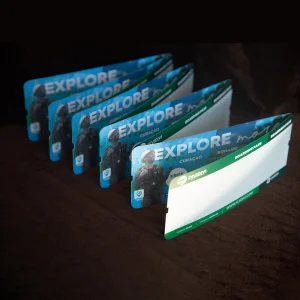
High-Quality Instant-Print Thermal Paper Tickets for Customizable Event or Service Factories, Product
View Details
High-Quality Adhesive Labels with Anti-Curl and Moisture-Resistant Sealed Backing Paper Factory, Product
View Details

China Detailed Booklet-Style Instruction Manuals for equipment or products Company, Products
View Details

Partner with Xiamen Lianhua Printing Co., Ltd. for Engineering-Grade Solutions
Established in February 1992, Xiamen Lianhua Printing brings over 30 years of OEM/ODM converting experience, ISO quality management, and RoHS/REACH compliant material standards to global B2B procurement partners.
Whether you require high-tack tire labels, flame-retardant lithium battery wraps, detailed equipment manuals, ABS dual-color engraved signboards, or custom-printed cards, our engineering team provides end-to-end technical support from material formulation to high-speed die-cutting delivery.